Most naming conversations end the moment the main name lands. The founder or C-suite picks a name, legal clears it, done. Time to launch.
But look closely at any brand that actually holds up over years, not months, and you'll notice something. The name was never the finish line. It was often the first word in a much longer sentence.
My take? The best brands aren't naming a product. They're building a vocabulary.
The One-Name Trap
Teams often treat naming as a single decision instead of a system. They nail the flagship name, feel great about it, and then wing everything that comes after. The loyalty program. The community. The annual event. The mascot nobody asked for but everybody loves.
Each of those gets named in isolation, usually by whoever's in the room that week. Comms names it. Product names it. Marketing names it three months later and contradicts whatever Product picked.
The result is a brand that sounds like five different companies wearing one logo.
What a Naming Ecosystem Actually Looks Like
A real naming ecosystem is about building a set of names that share DNA, so every new thing you launch feels like it was born from the same idea instead of bolted on.
That system usually stretches across:
- Sub-products and features that extend the core offering
- Community identity, what you call the people who show up
- Loyalty currency, the points, badges, or credits that reward them
- Events and summits that bring the brand into a room
- Content series that give the brand a recurring voice
- Mascots or characters that make the brand feel like someone, not something
Skip this, and every new launch becomes a fresh negotiation. Build it, and every new launch writes itself.
The Playbook, In the Wild
Nintendo didn't just launch the Wii (an oldie we named years ago!). They built Mii, the little avatar that became the face of the whole console. One console, one companion character, and suddenly Nintendo had a mascot system that could stretch across Wii Sports, Wii Fit, and every sequel that followed. The Wii sold the hardware. Mii sold the experience.
Apple may be the most disciplined ecosystem namer alive. The "i" prefix turned iPod into iPhone into iPad into iMac, a naming logic so tight it became shorthand for an entire category of consumer tech. Less visible but just as deliberate: their operating system names, first big cats (Panther, Tiger, Leopard), then California landmarks (Yosemite, Sierra, Sonoma). Nobody at Apple needed to name macOS versions after mountains. They did it anyway, because a naming system with personality gets talked about. People genuinely guess and debate what's next. That's not an accident. That's architecture doing marketing's job.
Here's a quieter one. IKEA names entire categories of furniture using a hidden taxonomy almost nobody clocks consciously. Bookcases get Swedish occupations. Kids' items get mammals and adjectives. Fabrics get flower and plant names. You've walked past a hundred IKEA names without realizing you were inside a fully built naming system, one designed decades ago and still holding.
And we've built this from the inside. When we renamed Corigin Ventures to Alpaca, the work didn't stop at the firm's name. We built out OneHerd, their platform supporting founders. The Rundown, their newsletter. Unpacked, their long-form content series. Every piece ladders back to the same herd logic, so the brand feels like one coherent world instead of a name with orphaned features hanging off it.
Why This Actually Matters
A scattered naming system doesn't just look messy. It costs you. Every unnamed or mismatched piece is a moment where your brand has to explain itself instead of simply being understood.
The brands people quietly admire, the ones where you catch yourself thinking of course it's called that, didn't get there by accident. They built a system that could absorb growth without losing coherence. That's not decoration. That's the difference between a brand people respect and a brand people have to have explained to them.
Try Building One Yourself
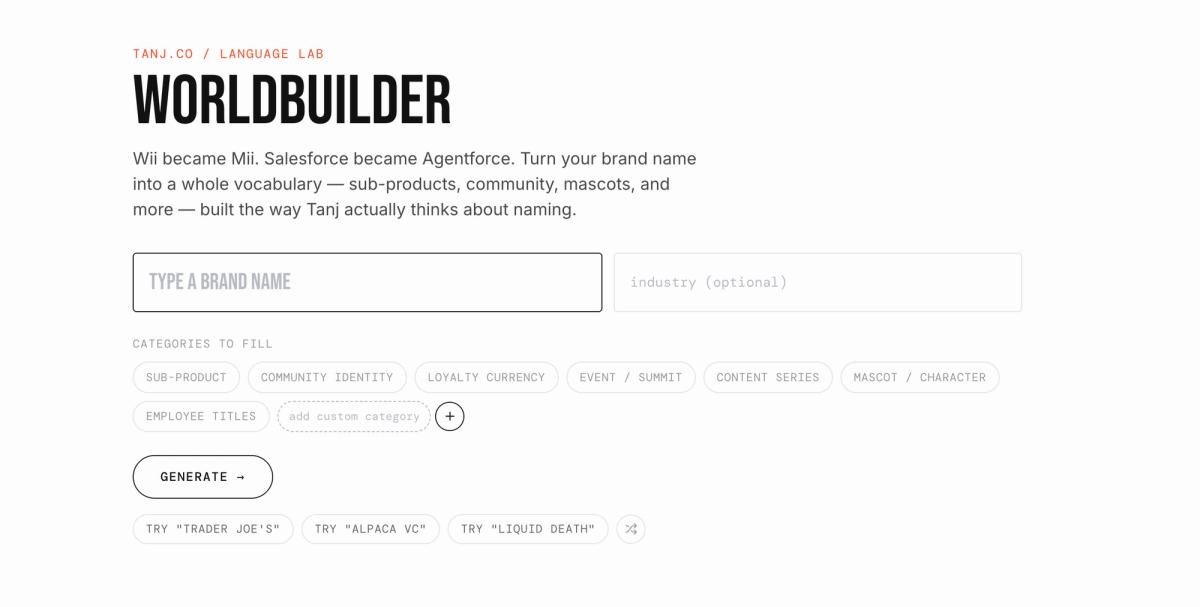
We built a tool for exactly this: Worldbuilder, live now in our Language Lab.
Drop in a brand name. Pick the categories you need filled: sub-products, community identity, loyalty currency, events, content series, mascots, even employee titles. Worldbuilder generates a naming ecosystem built the way Tanj actually approaches this work, not a random name generator spitting out disconnected words.
Try it on your own brand. Or throw a name like Trader Joe's or Liquid Death at it and see what a fully built-out world could look like.
What would your brand's vocabulary sound like if you actually built it on purpose?